Payment plans, milestones and invoices: collections without spreadsheets
Off-plan sales are paid over years, in instalments tied to dates and construction stages. Tracking that in a spreadsheet works until it does not. Here is a better structure.
An off-plan condo in Thailand is rarely paid at once. A typical buyer pays a reservation deposit, a contract payment, several instalments during construction, and the balance at transfer. Some instalments fall due on a date; others when construction reaches a stage, such as the structure being finished.
Multiply that by a few hundred units and you have the spreadsheet every developer's accounting team knows: one row per instalment, columns for due dates, amounts paid and notes, colour codes for overdue, and a weekly meeting to work out who to call.
It works until someone sorts one column without the others, or a construction stage completes and nobody updates forty due dates.
Start with payment-plan templates
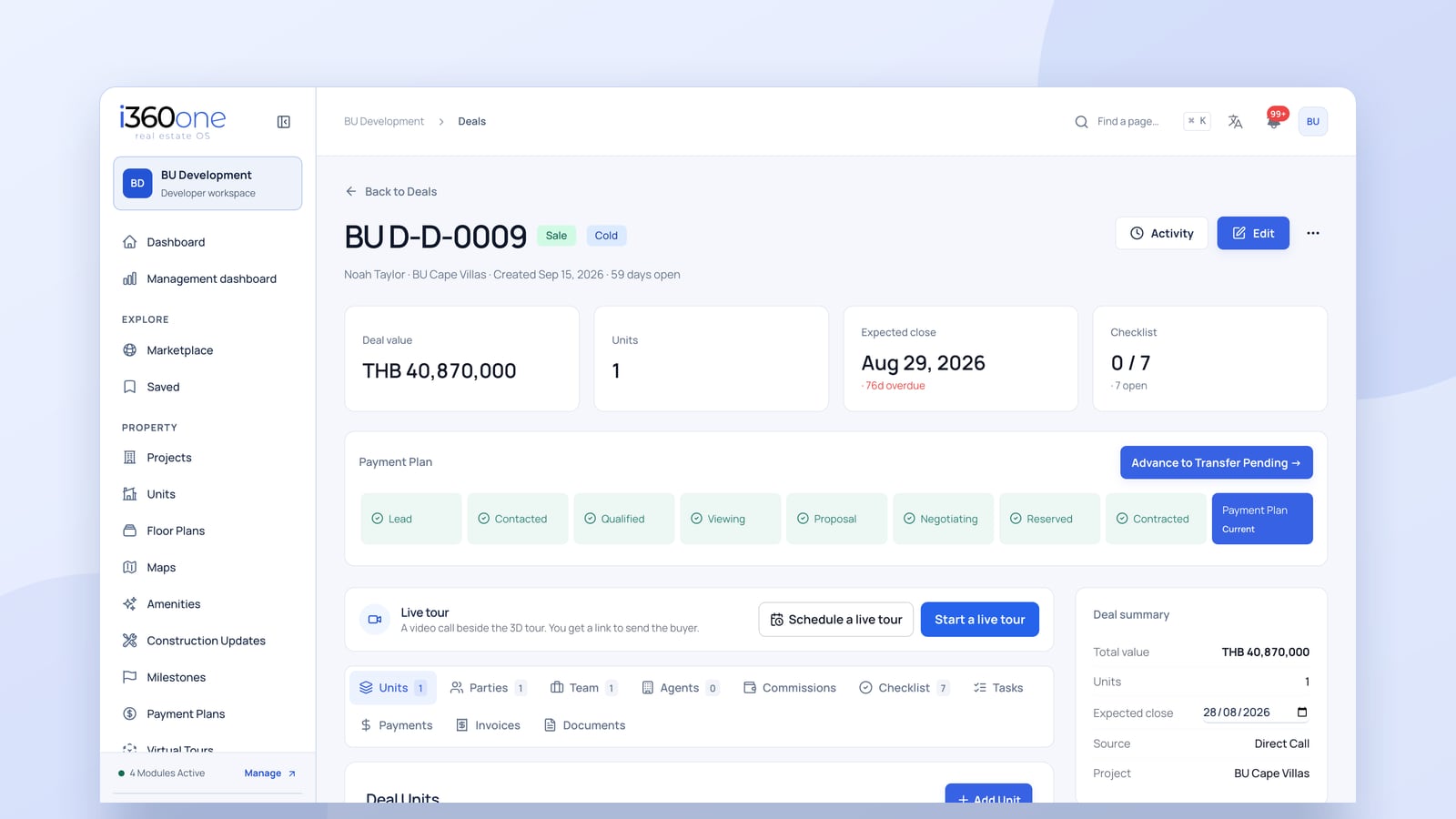
Most projects offer a handful of plans: standard, early payment, extended, perhaps a special plan for a promotion. A payment-plan template describes each plan once: the instalments, their share of the price, and when each falls due.
When a deal is made, its schedule comes from the template and the agreed price. The plan the sales team offered is exactly the plan accounting collects against, because it is the same plan.
Instalments tied to construction
Some instalments should not have a date at all. They fall due when the construction milestone they belong to is complete. In i360one, an instalment can be linked to a milestone of the project or unit: "due when the structure is complete".
When the project team marks that milestone complete, the due dates of the linked instalments are set. Accounting does not wait for an e-mail from site, and forty buyers' schedules are not updated by hand. If a milestone is marked complete by mistake and reverted, the due dates are cleared again.
This works because milestones and payments live in the same system as the project. It is the payment side of keeping buyers informed during construction.
Invoices from the schedule
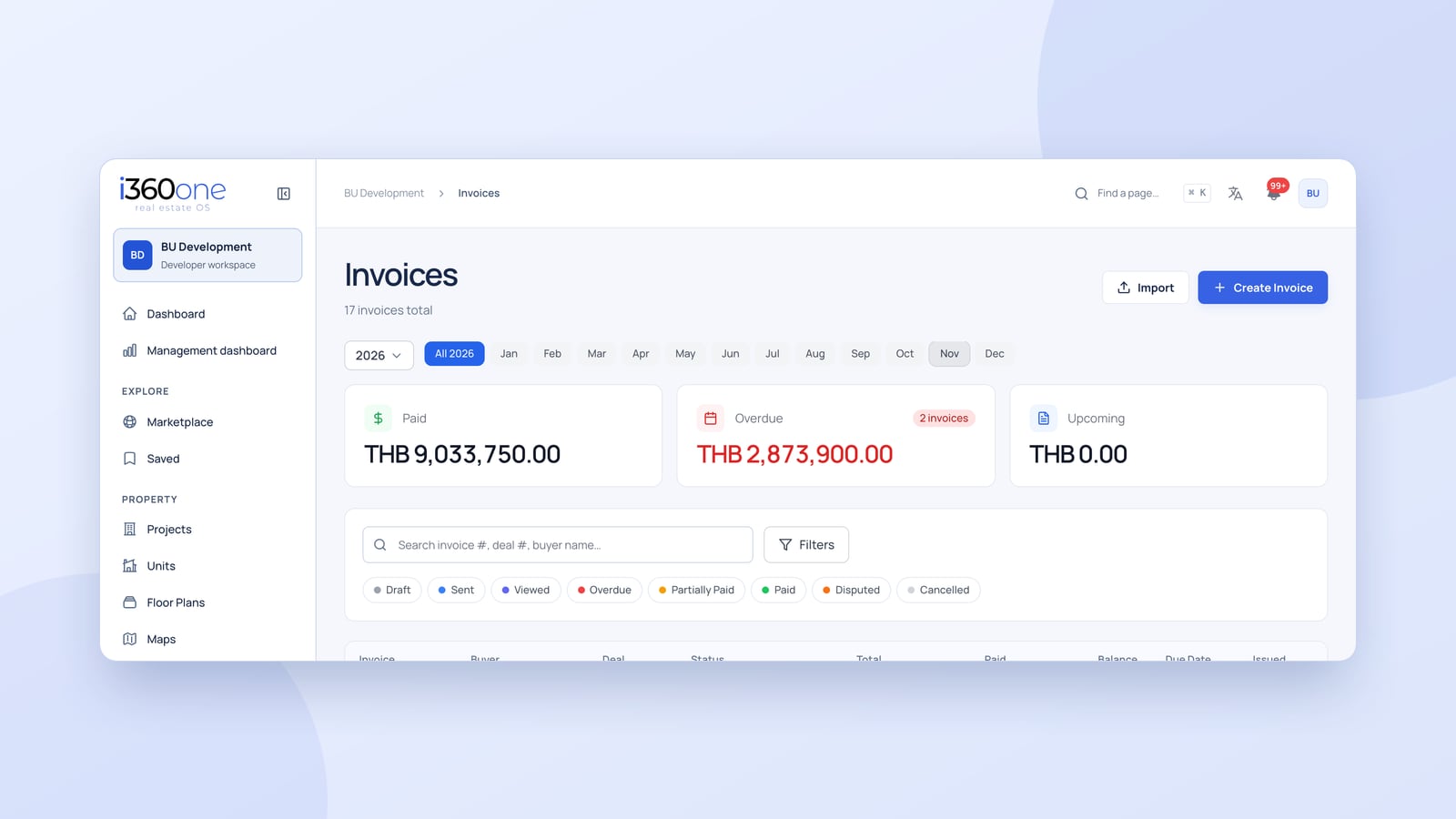
An instalment that falls due becomes an invoice. Invoices carry your company's branding, numbering and default terms, are sent to the buyer, and stay on the deal. Buyers can see the invoices issued to them in their own view, instead of searching their e-mail for the PDF.
Businesses that already have invoices in another system can bring them in through a CSV import, so the history is in one place.
Recording and confirming payments
Most property payments in Thailand still arrive by bank transfer. When a payment comes in, it is recorded against the deal and allocated to the instalments it pays. A confirmation step lets a second person check the payment against the bank before it counts, and a receipt can follow.
The deal then shows the truth at any moment: what was due, what was paid, what remains.
Overdue follow-up without a weekly meeting
Overdue instalments appear on their own, and the management dashboard's attention queue lists what needs action today. The person following up sees the deal, the schedule, the invoices and the conversation history together, instead of a row in a spreadsheet.
The awkward cases, kept with the deal
Real deals have exceptions, and they are where spreadsheets break first:
| Case | Where it lives |
|---|---|
| Refunds | a refund request on the deal, with its status |
| Credit notes | corrections requested and reviewed against the invoice |
| Deal credits | credit balances and how they are applied to payments |
| Transfer fees | the transaction costs and who pays them |
| Financing | the buyer's financing details and loan status |
| Disputes | the dispute status and its messages, with the invoice |
None of these needs a separate file. Each stays on the deal it belongs to, visible to the people who handle the deal.
What changes
Collections stop being a monthly reconstruction and become a daily list. Sales, accounting and management look at the same schedule, so the question "has unit C-1102 paid the third instalment?" has one answer, and anyone with access can find it in seconds.